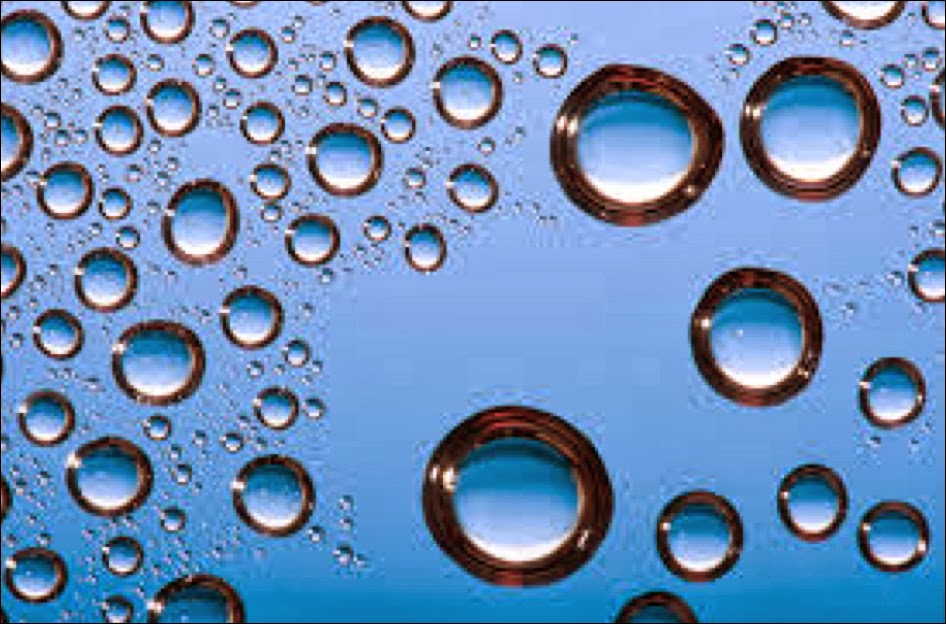
Showing posts with label hydrophobic. Show all posts

Tuesday, 1 July 2014

New Nano Tec' Hydrophillic Window Coatings

A nanoparticle-based coating from ARS, applied to the right half of this plastic container, prevents water from beading and reducing visibility.
http://phys.org/news/2014-07-nanoparticle-based-coating-beading.html
Nanoparticle based coating helps stop water from beading: When rain falls on a glass window or a plastic skylight cover, it often forms beads. That's because these surfaces typically are hydrophobic, meaning they repel water. But a transparent, nanoparticle-based coating developed by Agricultural Research Service scientists can quickly change surfaces from hydrophobic to hydrophilic, so that rain doesn't bead up, and your visibility isn't impaired.

When raindrops come in contact with the spray-on coating, they spread, instead of beading, explains chemist Sanghoon Kim, who headed the nanoparticle studies. Besides its potential use on windows, the coating might also be applied to solar panels, to help keep dirt from interfering with their performance. What's more, Kim and colleagues have observed that the coating works well on other materials, including Plexiglas and metals such as stainless steel.

Kim, chemist Atanu Biswas, and physical scientist Kervin Evans—all at the ARS National Center for Agricultural Utilization Research in Peoria, Illinois—created the coating's nanoparticles using only a few off-the-shelf laboratory chemicals, including an ag-sourced protein. From start to finish, production of the nanoparticles takes less than an hour, involves simple procedures with inexpensive chemicals, and doesn't require specialized equipment or costly heating.

In a proof-of-concept experiment, the researchers used bovine serum albumin as their protein and ethyl cyanoacrylate as the starting material that's key to creating the nanoparticles. Bovine serum albumin is a cattle industry coproduct. Ethyl cyanoacrylate is a major component of what's commonly known as "super glue." Simply stated, the nanoparticles were formed when ethyl cyanoacrylate reacted with bovine serum albumin in a solution of acidified ethanol. Spinning this mixture in a centrifuge removed any byproducts of the reaction, resulting in nanoparticles suspended in the solution.

Applying the coating is quick and easy. All that's needed is to spray it onto clean glass or other recommended surface, then rinse with water. Kim, Biswas, and Evans documented their results in a peer-reviewed scientific article published in 2013 in Colloids and Surfaces B: Biointerfaces.

In a followup study, Kim and colleague Yeon Seok Kim, of the National Institute of Standards and Technology, used gliadin—a protein from wheat—to demonstrate that their process is applicable to both plant- and animal-derived proteins. An article published this year in the Journal of Nanoparticle Research has details.

Typically, plant proteins are less expensive than those from animal sources. Regardless of which agricultural source is chosen, informal cost estimates suggest that the new coating could be made at the same or less cost than hydrophilic coatings already on the market.

The fact that the Peoria coating is rain-ready in about a minute apparently makes it unique. ARS is seeking a patent for the research, and the scientists are looking for industry partners, such as manufacturers of window cleaning products, to commercialize the invention.

The uncoated section (left) of a glass slide is peppered with water droplets whereas the coated section (right) has a thin film of water that makes the glass clear.
http://phys.org/news/2014-06-scientists-clearer-glass-permanent-superhydrophilic.html#inlRlv
Scientists create clearer glass with permanent, superhydrophilic ceramic coating: When it comes to fogged up glassware or windows, the best way to keep a clear view seems to be by wiping the water droplets away constantly or having coatings that prevent the water from sticking to the glass. However, scientists at A*STAR's Institute of Materials Research and Engineering (IMRE) have discovered that doing just the opposite - collecting the water to create a uniform, thin, transparent layer - actually helps produce a better, clearer view.

IMRE has invented a new technology, CleanClear, which is a durable and permanent ceramic coating that is transparent and superhydrophilic, which means it attracts water instead of repelling it. This creates a layer of water that prevents fogging on glass or plastic surfaces, and keeps surfaces cleaner for a longer period of time. Water-forming coatings create an additional uniform water layer to produce a better view as opposed to water-repelling technologies that form water droplets which impair vision.

Reduced visibility from fogged up glass or plastic surfaces is a common problem in wet or humid environments, and affects a multitude of products such as car windshields, spectacles, goggles, and even covers for cookware. The majority of solutions rely on water-repelling coatings. Unfortunately, current coatings are not durable and most have to be re-applied regularly.

How the technology works:

The new patented technology from A*STAR's IMRE is a one-time ceramic coating that can be applied onto glass or plastic materials at processing temperatures below 100oC. This is important as it makes the coating process simpler and ultimately, more cost-effective. Currently, commonly used chemical coatings degrade easily with continued usage and have to be re-applied. IMRE's new ceramic coating is durable, permanent and only needs to be applied once. Although there are also other similar "water-loving" coatings, these are often processed at much higher temperatures and can only be activated by ultraviolet (UV) rays or sunlight.

Large multinational companies also use alternative coatings like titanium dioxide (TiO2) to produce self-cleaning glass surfaces that prevent dirt and dust from sticking. However, the TiO2 ceramic coats can only be applied on surfaces during the manufacturing process at temperatures above 600oC. This limits their application to hard materials like glass. CleanClear can be adapted to multiple surfaces and materials, ranging from glass to plastics. TiO2 coatings are also activated by sunlight but IMRE's new coating does not require activation and continues to function even at night and in low-light, indoor environments.

There are many useful applications for IMRE's "water-loving" surface. For example, it can be applied on car windshields, mirrors and motorcycle visors, allowing for better visibility in the rain. Coating building exteriors with this new material allows for self-cleaning during rain. Due to its adaptability for application on various surfaces besides glass, this could also result in potential cost savings. CleanClear can also be applied to consumer products to reduce condensation on glass covers for pots, food containers and hot food displays.

"Conventional technologies mainly use organic-based materials and some with nanoparticles but these don't last long, and need to be re-coated from time to time. The CleanClear process makes the coating part of the surface – permanently," said Dr Gregory Goh, the lead scientist from IMRE who developed the technology last year.

"CleanClear could be used to help create a sort of a clear 'vision shield' for today's car windshields during heavy rain," added Dr Goh. "Or we could use it to replace current daytime, UV light activated coatings with an all-day, all-night CleanClear coat on building facades to keep glass cleaner."

Friday, 24 January 2014

Testing Glass Coating Products

Eliminate all traces of certain hydrophobic glass coatings.
http://glass-smart.blogspot.com.es/
Testing Glass Coating Products (written by Henry Grover Jr): We are professionals in what we do. So if we are to sell a coating application for window glass we should be able to explain with confidence how long the application will last, and under what conditions it will degrade. We also should be able to define exactly what the benefits will be to the customer. Because it is these benefits that we are selling. There are many different competing products out there. Some of them the customer has direct access to at the local Walmart. Others are now made available on brand new windows, shower doors, and mirrors. We should be concerned with these competing products. Since we will have to offer something better. We will have to offer a personal and professional guarantee.

Longevity is a concern. Some products will wear off in a single day. Others will last for a month. Then there are some that are advertised to last for six months. I have a running test on one that goes back ten years. On dark glass even. It is the suns UVC radiation that is mostly responsible for degrading coatings. Which by the way can be either hydrophobic or hydrophillic. As is demonstrated by the picture above this is determined by the size of water drops. A hydrophillic surface will show much larger drops. If you were to sell a coating as a professional applicator you absolutely would not want to tell the customer the brand name of the product used. In my opinion. The reason is very simple and plain. Each product out there has its own unique advantages. One advantage might be scratch resistance, another longevity, another hydrophylicity, and yet another is resistance to alkali degradation by mineral deposits/hard water spots. If I were to sell a coating application service at a substantial price, I would need direct personal experience with it. So that I could guarantee that it will do what I am applying it for. Sometimes it is possible to demonstrate the application. Such as the hydrophobic/hydrophillic balance. Or scratch resistance. Or even alkali degradation. Longevity is probably the most difficult. Unless you had a very powerful UVC lamp.

Lets look at alkali attack. I have proven that alkali attack at 9 to 9.5 pH will effectively eliminate all traces of certain hydrophobic glass coatings. Simply by putting small two inch droppings of concrete on a test plate treated by the coating in question. Leave the concrete on the horizontal test plate for a full 24 hours then remove. By running the plate under the tap it will become instantly apparent whether the coating has stood up to attack. Hard water reaches a very high pH the last few minutes of a water drops life as the water poofs away. Leaving behind mineral deposits. This high pH is what degrades the coating causing the mineral deposits to cling to the glass surface. If someone hires us to keep spots from sticking to their glass this kind of information would be helpful. But not absolute! We can only be absolutely confident (and get the bigger buck) by proving to the customer that our service will keep spots from sticking to their glass. This can only be done by means of a timed test. If the spots are coming from the efflorescence of the buildings exterior façade the option of diverting the sprinkler heads doesn’t exist.

What about scratching? I developed a very simple test for scratching. Definitely not an ASTM test. Where I just coated one side of a mirror with the product in question. Then I took a broken piece of glass and purposely tried to scratch the entire surface. One product I tested stood out. All other products failed really bad. My first question after this discovery was, will this product stand up to sand in the wind on a windshield? So;...I duplicated sand in the wind by performing a side by side test using a sandblaster set on low. It failed completely. You might look for independent studies done on certain products you are thinking of buying. My advice here however is to buy the product, or get a piece of glass in the mail that has been treated with the product you are thinking of buying, and test it yourself. Believe in your own ability to figure it out. It is your own personal confidence in the service that you are offering that will sell it. Every time!

Henry Grover Jr is currently involved in R&D writing. He writes a column for the Window Cleaning Business Owner magazine called SURFACES, and manages a sub-forum for the Window Cleaning Resource with the same title SURFACES. He is also working in developing what he calls custom products for both the Window Cleaning Industry and others involved in the maintenance, restoration, and preservation of window glass. He has given seminars in the past on glass stain removal/identification techniques, wrote tech articles for the American Window Cleaner Magazine, traveled for consulting work on several famous buildings, and worked in the capacity of a consultant for many window cleaning companies in different parts of the US. 

Go to www.glass-smart.blogspot.com to read more.

Wednesday, 11 December 2013

Talking Yard Signs & Hydrophobics

http://moleandjersey.com/
The Mole And Jersey Show - Episode 4: The Mole & Jersey Show: A new kinda show has come to town & we've liking it! A lot like Window Cleaning Nation only with a reckless abandon & inside jokes that probably only window cleaners would get. Last weeks episode 4 focused on a company in the States called Sign2Day owned by Tim Fields that sells signs directly to window cleaners & pressure washers.
Enjoy... the youtube video is below & as always I recommend you watch it directly at the link by clicking the youtube link in the bottom right-hand corner.


Henry talks about hydrophobic glass in the industry.
http://glass-smart.blogspot.com.es/
Creating Hydrophobic Glass (by Henry Gover Jr):  By its very nature window glass is hydrophilic. It loves water. So much so that it is necessary to heat the surface to at least seven hundred degrees Fahrenheit to completely eliminate all water vapor. Or we could make the surface hydrophobic with chemicals. The new surface serves as a microscopic barrier to water. This essentially stops any exchange reaction that routinely happens between the hydrogen atoms in water molecules and certain atoms in the glass surface. Put another way, such hydrophobic barriers stop the natural weathering process (etching) of window glass. Window Cleaners are well aware of this very interesting effect. When cleaning old storm windows it is always possible to tell the outside from the inside of a clean plate with both eyes shut. Just lightly feel both sides with your fingertip. Make sure the window is both clean and dry first. 

Over the years there have been many different products developed to make ordinary vision glass hydrophobic. Great interest has been shown by the owners of aircraft. These coatings make rain bead up and run off dramati-cally improving vision. They also help to keep windshields stain free and easier to clean. This is also true of window glass. Hard water stains are a constant problem these days. Acid rain is breaking up the minerals in the ground and dissolving the exterior concrete and brickwork of large buildings worldwide. Mineral deposits come from sprinkler heads and the leaching of concrete. They might be on the first level only or go up forty four floors. 

Hydrophobic glass - sometimes a problem for window cleaners.
Removing such stains safely requires much time and the correct technique. Which is very costly. Once removed however, the owner certainly doesn’t want their building to be marred again. Using the best hydrophobic product then is critical to prevent any new stains from locking on once again. Before attempting such a “restoration project” it would be a wise decision to hire a consultant who specializes in this type of work. The building should never be “acid washed”! Glass etchants such as hydrofluoric, sulfuric, or ammonium bi-fluoride can permanently damage the optical surface of window glass. They can also bring on lawsuits from the harm they do to the environment. Also they can do serious harm to those using them. 

Another interesting application of hydrophobic glass treatments is scratch resistance. If applied correctly there are some coatings that will stand up to broken glass used by vandals. Although not completely effective, they are very impressive. And will at least greatly minimize the scratch making it much easier to remove with an ad-vanced scratch removal system. 

So which one do you buy? Would you like to get in on this new technology? If so the first question you must answer is what is my application? Then don’t believe all the hype. If you want to find out if a certain product is go-ing to work for you then test it. Will it be used inside or on the outside in the direct sun? Some products are quickly degraded by ultraviolet rays. Is it intended for scratch resistance? Or is it going to be used just as a rain guard? If you are attempting to keep hard water stains from locking on to the window after the glass has been restored, you will need to experiment with several different products on the same window and allow several months to go by. 

Throughout this article I have not touched on the different chemistries used by the manufacturers of any product. This is because I believe it isn’t necessary. I believe it is much more important to understand what hydro-phobes are and what their potential use might be. It is also essential to know that each must be tested before used for each different application. 

http://glass-smart.blogspot.com.es/
Written ByHenry Grover Jr. - Henry Grover Jr is currently involved in R&D writing. He writes a column for the Window Cleaning Business Owner magazine called SURFACES, and manages a sub-forum for the Window Cleaning Resource with the same title SURFACES. He is also working in developing what he calls custom products for both the Window Cleaning Industry and others involved in the maintenance, restoration, and preservation of window glass. He has given seminars in the past on glass stain removal/identification techniques, wrote tech articles for the American Window Cleaner Magazine, traveled for consulting work on several famous buildings, and worked in the capacity of a consultant for many window cleaning companies in different parts of the US.

Tuesday, 15 November 2011

Nanotechnology That Repels Oils, Dirt & Water

An iPhone sprayed with NeverWet was submerged in water
Scientists have created a silicone-based spray that makes phones waterproof, clothes completely stain-proof and window-cleaning a chore of the past.

New 'Waterproofing' Spray Launched In US: Scientists have created a silicone-based spray that makes phones waterproof, clothes completely stain-proof and window-cleaning a chore of the past. The NeverWet spray repels water and oil so strongly that it keeps materials totally dry when they are immersed in liquid. An iPhone that had been coated with the product still worked while submerged in a bucket of water for 30 minutes, according to the spray's manufacturers Ross Nanotechnology. Fruit juice, sauce and other liquids simply slide off clothes and shoes that have been protected with the spray. "Water and heavy oils will just shoot off of it - chocolate, ketchup, mustard, that sort of thing," researcher Andy Jones told the Pennsylvania newspaper Lancaster Online. And glass that has had the spray applied becomes so slippery to dirt that it washes off in the next rain shower.


The company believes the spray is so versatile that it could protect metal against corrosion, prevent ice-build up on power lines, and produce self-cleaning building materials. It has even tested the spray in hospitals, where it prevented bacteria sticking to bedpans and toilet plungers. Dr Jones added: "It is very novel, and when you start thinking about it, you can think about how transformative the technology can be. You can use it everywhere." The NeverWet spray repels water and oil so strongly that it keeps materials totally dry when they are immersed in liquid. An iPhone that had been coated with the product still worked while submerged in a bucket of water for 30 minutes, according to the spray's manufacturers Ross Nanotechnology. Fruit juice, sauce and other liquids simply slide off clothes and shoes that have been protected with the spray. "Water and heavy oils will just shoot off of it - chocolate, ketchup, mustard, that sort of thing," researcher Andy Jones told the Pennsylvania newspaper Lancaster Online.
And glass that has had the spray applied becomes so slippery to dirt that it washes off in the next rain shower. The company believes the spray is so versatile that it could protect metal against corrosion, prevent ice-build up on power lines, and produce self-cleaning building materials. It has even tested the spray in hospitals, where it prevented bacteria sticking to bedpans and toilet plungers. Dr Jones added: "It is very novel, and when you start thinking about it, you can think about how transformative the technology can be. You can use it everywhere."

Friday, 24 October 2008

Friday Night Window Cleaning News

Glistening roof for tower: Copper roof to be surpassed as tallest ceiling in city Skylon's copper top. It's not just the autumn leaves that have turned from green to bronze. A recent makeover at the Skylon Tower has added some new lustre to a Niagara Falls icon. The top of the 520-foot tower now gleams like a shiny new penny, following a refinishing and sealing of its copper roof. Its look could last for decades, said the owner of a company that did the work in September. "What we're doing is restoring the copper to close to its original appearance, polishing it and buffing it up and putting a sealant on it," said Don Searle, the owner of Koala Building Maintenance. The Niagara Falls company that specializes in maintenance on high-rise buildings. It does maintenance work and window- washing for most of the high-rise hotels in the city.
The company had a dozen workers on the project from the end of August until the end of September refurbishing the copper roof on top of the 43-year-old observation tower. They stripped away the oxidization -the scientific term for rust -that had built up on the roof since the 520-foot tower was built in the mid- 1960s. Working high atop the iconic tower was an unusual job, though Searle said his employees enjoyed the view. "It's very relaxing -the best view in town." Despite the height, Searle said it was a very safe job because his company hired an engineer to prepare a work plan to keep workers safe in the unusual work conditions. They were working about fifty feet higher than the tower's observation deck level. The green appearance now stripped away had evolved over the years because the copper was exposed to rain and moisture in the air. It's the same process that gives the roofs on the Parliament Buildings in Ottawa their greenish look. When copper is left unsealed, the shine will turn to brown within a few months - think of how fast a penny loses its lustre. After years of being exposed to the elements, copper will turn green -think of the penny you find on the sidewalk. But the Skylon roof was treated with a sealant that should preserve the brighter copper colour for years to come, Searle said. People began calling the Skylon almost as soon as work began. As soon as 18-inch squares of green started to be stripped away, people began asking what was going on.
"We're taking down the 40 years of oxidization of that roof," Carr said. For more than four decades, the Skylon has been the tallest structure in Niagara Falls. At 524 feet from base to tip, the Skylon Tower is one of the tallest structures in Canada. The tower was built on a 13-acre site overlooking the falls at a cost of $12 million at the time. It opened to the public in 1965.
There are only about two dozen buildings in Canada taller than 490 feet (150 metres).
Most of them are office towers in downtown Toronto, including the 72-storey, 950-foot tall First Canadian Place. Toronto's CN Tower remains Canada's tallest freestanding structure at 1,815 feet and five inches. George Yerich has owned the Skylon since 1988. In the past 10 years, several high-rise hotels in the Fallsview area, including the Hilton, Embassy Suites and Sheraton Fallsview, each at 36 storeys have been erected. But the expansion of the Hilton Niagara, currently under construction on Fallsview Boulevard, will be 58 storeys. Once it's finished, the top of the new hotel will be higher than the Skylon's observation deck. Canadian Niagara Hotels has city hall's approval to build a 59-storey hotel tower on Falls Avenue, near the site of the old Oneida Tower that stands over Casino Niagara's site.


Team takes on new heights in rappelling training: CJ David peered up at the top of the Equitable Center in downtown Salem on Monday afternoon and watched Salem Fire Capt. Joel Malstrom rappel down the side of the building. "That's cool," said the boy, who turned 8 years old Monday. "I want to do that when I get older." Malstrom was training with the department's technical-rescue team, which includes 21 members, said Division Chief Reed Godfrey, who oversees safety and special operations.The team trains for high and low-angle rope rescue operations, confined spaces and vehicle extrication. Rappelling off the Equitable Center's 80-foot-tall roof was ideal for firefighters to learn from if they were ever sent to rescue, say, a painting crew or window-washing crew stranded by broken scaffolding, Godfrey said. Some of the workers who were repainting the outside of the Equitable Center stopped to watched the firefighters practice.
"Our painters are quite thrilled that they're being proactive in saving them," said Susan Miller, the Equitable Center building manager.

Memorial night for tragic young dad: A Memorial night is being held for a young dad who died after falling from ladders at work. Window cleaner Graham Clark, 21, from Tyne Dock, South Shields, fell 15ft at a house in Laygate, South Shields, on May 31. He suffered serious head injuries and spent almost a week hooked up to a life support machine, which was switched off after tests showed he was no longer responding. His fiancée, Katie McGovern, 18, was pregnant at the time and recently gave birth to their second child, Rhianna, a sister for 11-month-old Mason. A friend of the family is now organising a night in his honour at Whiteleas Social Club, Oswald Street, South Shields, on Friday, November 7, from 7pm to 11pm. Tickets are £4, available on the door, and funds raised will be donated to a charity of the family's choice.Dad Michael, 50, said at the time of this son's death: "Graham might not be around any more, but he will never ever be forgotten."
A mustached foreigner looking for love in New York City sounds like it could be the plot to Borat. Pussyfoot, the new comedy from first time writer/director Dusan Sekulovic, has already drawn comparisons to the 2006 comedy. This feature, however, began shooting in late 2005, a full year before Borat put Kazhakstan on the map. In Pussyfoot, resident alien Irwin (Dusan Sekulovic, also starring in the film) is looking for girls. Not women. Girls. Preferably Jewish ones with one leg. We find him at the beginning of the film pining over having business cards with an important sounding title in order to attract these girls, with something like Executive Production Manager (Irwin is actually a window cleaner for Transparency Inc.). He ends up with a box of misprinted cards (instead reading Produce Manager), and it's back to square zero in finding someone to love him for him in this "second coming-of-age" story.


It took Guinn a year-and-a-half to learn the cobbling trade, but he has also taken on another one, something he initially learned as a teenager: window washing. "It's been a good sideline," he said, acknowledging a school of thought which says achieving streakless windows amounts to something of an art. "Some people say it is. I just say it takes a lot of practice." This day, the tools of his window-washing trade were outside in the bed of his pickup truck. Meanwhile, the space inside his place of primary employment was crowded with the other goods of his livelihood, including his tools, hats like the one he was wearing, belts, polish, even moccasins for folks who prefer that form of footwear. Looking around, Guinn pronounced himself satisfied with his surroundings. As for the future ... "This is probably what I'll be doing," he said with a smile, "until I'm not."


15-Second Pitch-Bluebird Window Cleaning: Business: Bluebird Window Cleaning. Number of employees: Two. Contact: David Vogeli. The company's pitch: Bluebird Window Cleaning is an authorized dealer of the restoration process that removes moisture and condensation from in between window panes. We can save customers up to 70 percent over the cost of window replacement while eliminating foggy window problems and restoring windows' original R-value, the measure of resistance to heat flow.
3M Earnings Call, Third Quarter 2008: Safety, Security and Protection Services sales rose 27% to $1 billion with the recent acquisition of Aearo Technologies contributing 19 points of growth. Organic sales was 9%, led by growth in personal protection solutions, protective window films, and cleaning solutions for commercial buildings. Operating income rose 42% while margins increased 2.3 points year-on-year to 22.8%. Sales were strong across the globe, led by double-digit sales increases in the U.S. and Asia Pacific.

Cleland family compete at Idol 2008 final: A 12 year old school boy and a singing window cleaner from the same family in Cleland have snatched a spot in the regional final of the nationwide Idol 2008 competition. St Aidan's High School pupil Ryan Hardie (pictured) and his uncle Samuel Pratt (39) battled their way through auditions back in September and now they are in with a shot of reaching the grand final which could see them win a recording contract to release a single.Ryan impressed judges with his rendition of the Bob Seger track Old Time Rock And Roll and Samuel opted for swing classic Fly Me To The Moon by Frank Sinatra to bag a place in the regional final.Now the singers are practicing hard before they have to face the judges all over again at Glasgow's Royal Concert Hall on November 2.

A Warwick-based window washing and blind-cleaning service won the third annual Orange County Chamber of Commerce Business Idol Award for 2008. DirtyBlinds.com is owned and operated by the husband-and-wife team of Pete and Tammy Artusa. The firm has been in business less than a year, but beat 14 other local businesses for the award. The Orange County Business Idol competition was held as part of the Chamber’s Expo Business Trade Show at Anthony’s Pier 9 in New Windsor. Runner-up businesses included Wiles Chiropractic of Marlboro and Lippincott Manor of Wallkill. The Artusas will receive a marketing makeover for their business valued at more than $12,000. The grand prize includes a written business plan, design and printing of a new trifold brochure, free chamber membership for 2009, free booth at the 2009 expo, miscellaneous public relations and advertising consulting, and free advertising on radio and television.

Bugs 'at the cutting edge of solar technology.' Queensland researchers say insect wings could hold the key to better solar panels and self-cleaning surfaces. The researchers from Griffith University's scanning probe microscopy department have used advanced microscopes to observe and measure structures on the wings of about 200 common insects. They recreated the nano-structures - measuring in the millionths of a millimetre - on man-made materials such as plastic to either repel or attract water. Research leader Greg Watson said creating a surface that adhered to anything or a surface that nothing adheres to was one of the ultimate goals of material science. "Insects that lay their eggs in water such as dragon flies have super-hydrophobic (super water-repelling) structures on their wings in order to repel water," Dr Watson said. "This enables them to skim close to water bodies and fly off dry. "Others, such as certain termites, have super-hydrophilic (super water-attracting) structures that attract and adhere to water. "This ensures that when the insect comes into close proximity with a suitable damp nesting site the insect is immobilised at this location, forcing it to detach its wings, find a mate and nest."
He said while insect wings appeared smooth, they actually feature a landscape of highly specialised nano-sized structures, the depth, proximity and size and shape of which determine their special ability. Researchers have since managed to take nano-scale imprints of the wing structures to duplicate the structures on polymers to create materials with the same properties as the wing. "The possible applications of this research are enormous and varied," Dr Watson said. "If we could make fabrics with super hydrophilic and hydrophobic patterning, we could use these to collect and channel water from the air. "Self-cleaning water-repellent coatings on ships would save a fortune in fuel costs and minimise the use of toxic antifouls, and of course anti-reflective properties could be applied to everything from window glass and spectacles to solar cells and stealth aircraft. "Nature has provided us with a free proven technology that has been finely tuned through evolution over millions of years to aid species survival."

Sunday, 27 July 2008

The Lotus Effect & Hydrophobic Coatings


The lotus effect in materials science is the observed superhydrophobic (also super hydrophobic or super-hydrophobic) and self-cleaning property found with lotus plants' leaves. In some Eastern cultures, the lotus plant is a symbol of purity. Although lotuses prefer to grow in muddy rivers and lakes, the leaves and flowers remain clean. Botanists who have studied lotus leaves have found that they have a natural cleaning mechanism. This cleaning mechanism was discovered by Wilhelm Barthlott in 1982. He also holds a patent. The microscopic structure and surface chemistry of the leaves prevent them from being wetted by liquids having a contact angle of greater than 90° to an unstructured surface of the same material. With contact angles to water of up to 170°, droplets roll off a leaf's surface like mercury, taking mud, tiny insects, and contaminants with them. This is known as superhydrophobicity, or more commonly, the lotus effect. Water droplets on taro and nasturtium leaves exhibit similar behavior. Some nanotechnologists have developed treatments, coatings, paints, roof tiles, fabrics and other surfaces that can stay dry and clean themselves in the same way as the lotus leaf. This can usually be achieved using special fluorochemical or silicone treatments on structured surfaces or with compositions containing micro-scale particulates. Super-hydrophobic coatings comprising Teflon microparticles have been used on medical diagnostic slides for over 30 years. It is possible to achieve such effects by using combinations of polyethylene glycol with glucose and sucrose (or any insoluble particulate) in conjunction with a hydrophobic substance. Water repelling glass panels have also been brought onto the market for use on the roofs of conservatories. StoCoat Lotusan is an exterior coating (paint) that mimics the microstructure of the lotus leaf surface, gaining similar water-repellent and self-cleaning properties, termed the Lotus-Effect. Water does not adhere to the surface, but rolls off the paint, picking up and washing away debris in the process. By remaining dry, the coating also resists mold, mildew, and algae. Though hydrophobic, the coating is highly permeable to water vapor. Lotus effect superhydrophobic coatings applied to microwave antennas can significantly reduce rain fade and the buildup of ice and snow.
Don't forget to check out the fish swimming around on the lotus leaf here.
.


Artificial Lotus Effect: Carbon nanotubes with nanoscopic paraffin coating form superhydrophobic, self-cleaning surfaces. Never wash your car again? Never clean your windows? These may well become reality if it becomes possible to produce the right coatings—coatings that imitate the self-cleaning effect of the lotus blossom. A research team led by Ayyappanpillai Ajayaghosh at the National Institute for Interdisciplinary Science and Technology (Trivandrum, India) has made significant progress toward this goal. As they report in the journal Angewandte Chemie, these scientists have successfully produced a superhydrophobic, self-cleaning surface. Their success results from carbon nanotubes having a nanometer-thick paraffin coating with the help of a rigid aromatic molecule called para-phenylenevinylene. The lotus plant has given its name to a natural self-cleaning mechanism: The extremely water-repellent (superhydrophobic) surface of its leaves causes drops of water to form spheres, which roll off the leaf, sweeping any dirt away. The lotus leaf is equipped with 3 to 10 µm “bumps” that are in turn coated with a nanoscopic water-repellent coating. The bumpy structure minimizes the area with which the water can come into contact and the water-repellent coating keeps water from getting into the valleys between the bumps. The water cannot coat the leaf and simply rolls off. The researchers started with carbon nanotubes—long, hollow fibers made of carbon atoms in a honeycomb-like arrangement. Using a self-assembly process, they attached organic molecules to the exterior of the tubes. These molecules consist of a short backbone of aromatic six-membered carbon rings that supports several long hydrocarbon chains. The aromatic rings attach themselves firmly to the honeycomb structure of the nanotubes; the hydrocarbon chains act like a paraffin-like coating. The research team applied a dispersion of these adducts to glass, metal, and mica surfaces. Once dry, the result was a water-repellent coating with stable self-cleaning properties. Electron microscopic images show that the coating does not have a regular structure like the leaves of the lotus, but does have comparable nanoscale roughness. Water has as much trouble coating these artificial surfaces as the lotus leaf. A tilt angle of 2° is sufficient to cause water droplets to roll off. Like the lotus, any dust is removed from the surface by the water droplets.

Search This Blog