
 |
| Window cleaners see this a lot: A detailed impression of a bird, possibly a pigeon, was left when the bird hit a west-facing window pane in the skywalk over Michigan Street between Wells Fargo and the DECC sometime in the past week or two. The beak, feathers and wing feathers are seen in great detail. The white material might be a fine, waxy substance from powder down feathers. |

Ghostly bird image on downtown Duluth window inspires flights of fancy: The detailed mark of an unknown bird’s mid-flight collision with the skywalk is a little hard to see from certain angles. It looks like someone dipped a pigeon in flour and then pressed it carefully against the glass of the skywalk over Michigan Street behind the Wells Fargo building. Those who stopped to study the impression Friday had a mix of responses. Alan Svoboda, a designer, had an artistic take and said it was “kind of great.” He took a photograph of the image. Svoboda liked the idea of creating similar vinyl decals on skywalk windows. “Let’s keep it weird,” he said.
Such silhouettes can be made from powder down, a substance that protects growing feathers, said birding expert Laura Erickson. Or it could be from a coating of dust on the window, she said, or a combination of both. Erickson said the collisions happen more often during times of migration. Birds have to pass through downtown Duluth to clear Lake Superior. It happens during foggy nights and early in the morning. “They get confused by lights in windows or reflections in the glass,” she said.
Mary Dontje, who regularly passes the spot, said the bird smudge has been on the window at least a week. A similar full-spanned mark of another bird was on the adjacent window. “It makes you sad,” she said. “They were probably going full steam. You wonder if they died or recovered.” Russ Holm said he saw a very detailed bird outline on the bridge that crosses Interstate 35 about five years ago. The individual wing details were visible on that one. This one wasn’t as impressive, he said. “I’ve seen better,” Holm said.
Such silhouettes can be made from powder down, a substance that protects growing feathers, said birding expert Laura Erickson. Or it could be from a coating of dust on the window, she said, or a combination of both. Erickson said the collisions happen more often during times of migration. Birds have to pass through downtown Duluth to clear Lake Superior. It happens during foggy nights and early in the morning. “They get confused by lights in windows or reflections in the glass,” she said.
Mary Dontje, who regularly passes the spot, said the bird smudge has been on the window at least a week. A similar full-spanned mark of another bird was on the adjacent window. “It makes you sad,” she said. “They were probably going full steam. You wonder if they died or recovered.” Russ Holm said he saw a very detailed bird outline on the bridge that crosses Interstate 35 about five years ago. The individual wing details were visible on that one. This one wasn’t as impressive, he said. “I’ve seen better,” Holm said.

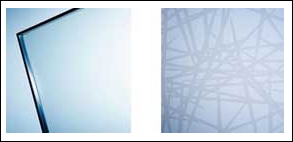
Spider Webs Inspire 'Bird Safe' Windows: A glass inspired by spider's webs is being used to keep birds from smacking into windows. Birds can't see glass well, and so many of them die when they hit picture windows. Humans can't see glass well either, which might explain why some people try to walk through glass doors. But most people know that the refection of the sky and landscape in a window isn't real -- unfortunately, birds don't. According to the Fatal Light Awareness Program, a building with glass walls or windows can kill up to 10 birds per day, and estimates of worldwide deaths from such collisions reach hundreds of millions of birds each year.
The glass was tested in a flight tunnel in the United States. Birds were allowed to fly to one end of the tunnel which was covered with two types of glass, one with the UV-reflective coating. The birds avoided hitting the coated glass up to 68 percent of the time. (No birds were hurt in the testing because researchers used a net to prevent the birds from impacting the glass.) The glass is also being used by a Canadian wildlife center, a German zoo and a mountain railway building in Austria.
 |
| An example of how deceiving glass reflection can be to birds. |

The Fatal Light Awareness Program (FLAP) is a non-profit organization
governed by a Board of Directors, and sustained by the tremendous
efforts of approximately 100 dedicated volunteers. Many species of birds migrate at night. Guided in part by the constellations, they are attracted to the bright lights left on overnight in urban areas, causing them to collide with buildings. During the day, windows confuse migratory birds. They cannot see the pane of glass. Instead, the birds focus on the reflection of trees or sky, or see through the glass to a potted plant inside the building. The result is often a fatal collision. FLAP is the first organization in the world to address the issue of birds in collisions with buildings. Since 1993, our volunteers have picked up over 50,000 injured or dead birds from 164 species in the Toronto region. 64 of these species are in serious population decline, and this includes several species deemed at risk under Federal legislation. 40% of the injured birds, rescued by FLAP, survived to be released back into the wild. Concerned groups in New York City, Chicago, Montreal, and Minneapolis-St. Paul have since created similar organizations. A network of protection for migratory birds is emerging from this collective effort.

Bird-Safe Glass Being Used At UK Lookout Tower: A special type of glass coating, developed by a German company and inspired by spider webs, is being used for the first time in the UK to help protect birds flocking to an island off the northeast coast of England. The glazing, which is known as Ornilux and is visible to birds but invisible to humans, was developed by researchers at Arnold Glas and is being used at a lookout tower at The Holy Island of Lindisfarne in order to keep the “hundreds of species” of birds that flock there at specific times of the year, BBC News reported on Friday. Previously, the substance, which can reportedly reduce bird collisions by as much as two-thirds, has been used by a Canadian wildlife center, a German zoo, an Austrian railway building, and a U.S. school. However, Lindisfarne is the first UK facility to make use of the UV coating that was first introduced to Europe in 2006.
“A friend of the owner of the company saw an article about the Orb-weaver spider,” Arnold Glas export manager Natalie Kopp told the BBC. “Its web reflects UV light protecting it from being destroyed by birds as they can see it and do not fly through. The idea of developing a coating for glass… inspired by nature was born on the same evening.” According to the company’s official website, bird window strikes is one of the greatest threats to avian mortality (second only to habitat destruction), largely because of the “reflective and transparent characteristics of glass.” In order to prevent those collisions, the company’s bird-protection glass has a patterned, UV-reflective coating that makes it appear transparent to people, but observable to birds.
Ornilux was first tested in a flight tunnel at the American Bird Conservancy, and according to the BBC, those tests involved birds flying towards an end of the facility covered with both glass and the special glazing. Nets were used and no birds were harmed in the experiment, the firm said, and the trials revealed that the Ornilux glass coating could prevent up to 68% of avian collisions. “The safety measure comes at a cost. The product is significantly more expensive than alternative measures such as placing semi-transparent UV-coated stickers across windows. But it has the advantage that it does not spoil the view for humans,” the BBC said, adding that the visibility factor played an important part in the decision to use Ornilux at the Lindisfarne lookout tower, a landmark originally built in the 1940s.
“We have a massive increase in birds at certain times of the year and the building is going to be there permanently,” Lindisfarne development officer David Suggett told the British news organization. “From the outside to the human eye the glass looks absolutely normal – it just looks like it’s see-through. But if you are a member of the public and you go inside and you go very close to the glass at a certain angle you can see very fine veins running through it and this is what the birds pick up on when they are flying round the tower.”
“A friend of the owner of the company saw an article about the Orb-weaver spider,” Arnold Glas export manager Natalie Kopp told the BBC. “Its web reflects UV light protecting it from being destroyed by birds as they can see it and do not fly through. The idea of developing a coating for glass… inspired by nature was born on the same evening.” According to the company’s official website, bird window strikes is one of the greatest threats to avian mortality (second only to habitat destruction), largely because of the “reflective and transparent characteristics of glass.” In order to prevent those collisions, the company’s bird-protection glass has a patterned, UV-reflective coating that makes it appear transparent to people, but observable to birds.
Ornilux was first tested in a flight tunnel at the American Bird Conservancy, and according to the BBC, those tests involved birds flying towards an end of the facility covered with both glass and the special glazing. Nets were used and no birds were harmed in the experiment, the firm said, and the trials revealed that the Ornilux glass coating could prevent up to 68% of avian collisions. “The safety measure comes at a cost. The product is significantly more expensive than alternative measures such as placing semi-transparent UV-coated stickers across windows. But it has the advantage that it does not spoil the view for humans,” the BBC said, adding that the visibility factor played an important part in the decision to use Ornilux at the Lindisfarne lookout tower, a landmark originally built in the 1940s.
“We have a massive increase in birds at certain times of the year and the building is going to be there permanently,” Lindisfarne development officer David Suggett told the British news organization. “From the outside to the human eye the glass looks absolutely normal – it just looks like it’s see-through. But if you are a member of the public and you go inside and you go very close to the glass at a certain angle you can see very fine veins running through it and this is what the birds pick up on when they are flying round the tower.”

Testing Special Glass: Even when there's no reflection, glass confuses birds. "The other thing that happens," Sheppard says, "is that birds will try to fly through glass to something that's on the other side. This can be a planted atrium. It can be a potted plant." So Sheppard has set up an experiment at Powdermill. She's putting birds in a tunnel that sits in a grassy part of the reserve. It looks like a house trailer. Two panes of glass enclose one end — there's regular plate glass on one side; next to it is a pane of specially coated glass. Sheppard is testing various coatings on and in glass that are visible to birds, but not to people. A fine mesh net just in front of the glass keeps the birds from actually hitting it.
Luke DeGroote comes to the tunnel with the morning's catch: catbirds. They screech, though not like any other bird you've heard. "They get their name from that catlike sound that they make," says DeGroote. The birds are in cloth bags; DeGroote wears several tied on a string around his neck. Sheppard's assistant, Cara Menzel, takes one and gives it a number — this one is 49931. Then she gently puts it in the tunnel. A camera mounted in the trailer wall focuses inside and films which glass window it flies toward. "Direct left," she says. The bird flew directly to the left, toward the regular glass. The glass on the right has a pattern of lines painted on the inside, and the idea is to see if the bird will avoid it. The pattern is made of a material that reflects ultraviolet light. Birds see well in the ultraviolet range. Presumably, they see the pattern as something solid; the human eye can barely make it out.
But Menzel notes that when the sun sets, it's a whole new problem — "especially during these big migrations," she explains, "where the birds are coming through in larger numbers, and a lot of them fly over at night." Biologists believe birds are attracted to the lights inside buildings at night. Sheppard has studied birds all her life. She says the real difficulty is trying to think like one — to figure out why they do what they do. There's been some research in Europe on bird-friendly glass, but not much here. "Not enough people know about it, and it's really important," she says. "Many people believe that birds have an intrinsic right not be killed. Birds are seed dispersers; they eat tons of bugs. So every bird that's killed on a building is an ecological service that we lose."
Several cities in the U.S. and Canada either have or are considering new building codes that require bird-friendly materials. And there are some quick fixes for windows — decals or sheets of patterned plastic that attach to glass. But ideally, biologists and architects want solutions that people can't see and that will be standard products in buildings — and that won't cost an arm and a leg.
Luke DeGroote comes to the tunnel with the morning's catch: catbirds. They screech, though not like any other bird you've heard. "They get their name from that catlike sound that they make," says DeGroote. The birds are in cloth bags; DeGroote wears several tied on a string around his neck. Sheppard's assistant, Cara Menzel, takes one and gives it a number — this one is 49931. Then she gently puts it in the tunnel. A camera mounted in the trailer wall focuses inside and films which glass window it flies toward. "Direct left," she says. The bird flew directly to the left, toward the regular glass. The glass on the right has a pattern of lines painted on the inside, and the idea is to see if the bird will avoid it. The pattern is made of a material that reflects ultraviolet light. Birds see well in the ultraviolet range. Presumably, they see the pattern as something solid; the human eye can barely make it out.
But Menzel notes that when the sun sets, it's a whole new problem — "especially during these big migrations," she explains, "where the birds are coming through in larger numbers, and a lot of them fly over at night." Biologists believe birds are attracted to the lights inside buildings at night. Sheppard has studied birds all her life. She says the real difficulty is trying to think like one — to figure out why they do what they do. There's been some research in Europe on bird-friendly glass, but not much here. "Not enough people know about it, and it's really important," she says. "Many people believe that birds have an intrinsic right not be killed. Birds are seed dispersers; they eat tons of bugs. So every bird that's killed on a building is an ecological service that we lose."
Several cities in the U.S. and Canada either have or are considering new building codes that require bird-friendly materials. And there are some quick fixes for windows — decals or sheets of patterned plastic that attach to glass. But ideally, biologists and architects want solutions that people can't see and that will be standard products in buildings — and that won't cost an arm and a leg.
More blogs on bird-strikes here.


