
Showing posts with label mr longarm. Show all posts

Friday, 13 August 2010

Melbourne Window Cleaners DIY A Curve Pole


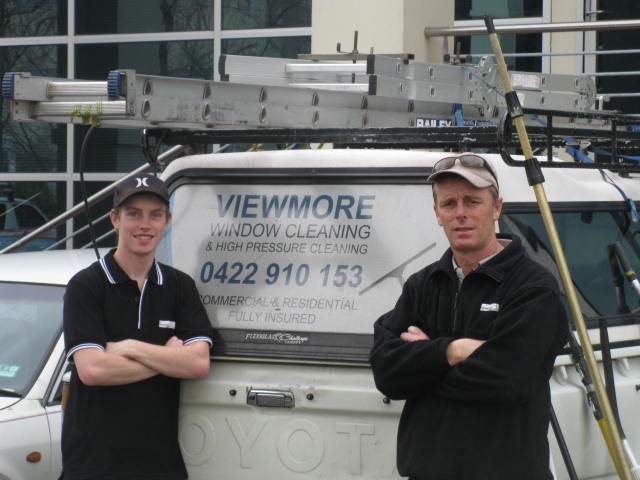
"Viewmore Window Cleaning" is a family operated business with 2 generations working in the window cleaning industry. John Harrington is the owner/operator and has been living and working in the Bayside suburbs of Melbourne for over 25 years. Two years ago his son Daniel joined the business and together they have been able to offer a genuine service to their clients based on good old fashion service and values." This article was kindly submitted by John Harrington of "Viewmore Window Cleaning" in Melbourne. Don’t forget to visit his website - Melbourne Window Cleaning – Viewmore Window Cleaning.


"Daniel earlier this week launched his own site, Window Cleaning Forum Australia which is aiming to become an interactive site with high quality information about window cleaning in Australia. Having noticed that there was no online discussion sites for window cleaning in Australia, and that the only specific information required you a fee to join their site, Daniel decided to start his own with the hope that contributing window cleaners across the country will help grow the site." Discuss this article on the forum.

DIY Curve Pole for $20

Introduction:


Seen those fancy curved window cleaning poles that have a curved top section of the pole to give you a better angle when window cleaning? Not sure if it worth spending the money on? Well I’ll teach you how to make a simple, cost effective version, that works just as well and is more customizable to your required task. All prices in Australian dollars (AUD) What do you need?

• $10 A window cleaning pole. We use a pole from the pool cleaning section at K-Mart.
• $5 Window Cleaning Pole Tip
• $5 Irrigation Pipe (Check your local hardware)
• $0.50 Super Glue
• A few spare cable ties.
• Heat Gun (not included in price).

How much is the official Mr Longarm Pro Curve?
12’ 3 Section $41.00 AUD (not incl postage from USA)
18’ 3 Section $51.50 AUD (not incl postage from USA)
Step 1:

Assemble all your equipment to your work station, you should have some of the required pieces lying around (super glue and cable ties) so that will be easy to get. You can see exactly what I used below, the pole is a short 8 foot version, but you can use whatever size you like.


Step 2:
Take your irrigation pipe, this is what we will use to create the curved section of the pole.
This is optional: Cable tie the bottom of the pipe to a chair leg to get a perfect bend.

Take your heat gun, and aim it at the point where you want the bend to be. Where the heat gun is aimed will be the center of the curve as it will curve the surrounding areas too. Maintain the heat gun, and bend the pipe by pulling/pushing (depending on where you are standing) from the top of the pipe until you reach a degree of curvature that you are satisfied with. The pipe will reduce the bend slightly as it cools, so you should factor that into your calculations. It was cold when I made my pole, so it cooled fairly quickly but you can place it in a bucket of water if you want it to cool almost instantly.


Step 3:
Using your heat gun again, this time heat the end of the pipe you are going to be connecting the tip of the pole to. Heat the end of the pipe until it becomes soft enough to slide the tip in firmly. You may need some glue to keep it in place if the tip is slightly loose. In my case, it was a perfect fit and is incredibly solid without glue.


Step 4:
Putting it all together! This is a fairly straight forward step, all you need to do is slide the pipe in the top of the pole. It will only slide as far as the bend, so you don’t need to worry about how far to push it, although you want a reasonable length of pipe inside the pole in order for it to be strong enough to handle pressure. If you find the pole twists, which it likely will, just place either some super glue around the pipe and slide it back in. The glue will fasten and hold the pipe in place.


Finished Product:


Optional Steps:
1. Due to the angle of the curve, the steel pole itself won’t come in contact with the window you are cleaning, hence why this is an optional step. You can wrap the end of the steel pole, where you slid the pipe in, with duct tape or something similar in order to create a buffer between the metal edge and any glass. This will provide a greater level of strength to the pole as any twists will have resistance from the glue and the tape.

2. Also if you use wagtail squeegee’s, they work very well on this pole, you just need to create a marker near the tip of the pole so you can line it up correctly.
Customize it!

The pipe is able to be bent to any angle, so you can make it as curved as you want! You could even make the curve longer make it similar to the goose neck of a water fed pole to reach into deeper ledges and sills. Let us know how you went by posting pictures and sharing ideas in our forum.

Editors note: This article in no way or form stipulates that building this pole will emulate the unique properties found in the Mr. Longarm Pole with it's own unique twisting & cleaning action.

Friday, 6 November 2009

Window Cleaners Adapt to Architecture


The most recent edition of the European Cleaning Journal (ECJ) contained an article of the challenges of window cleaning today. Michelle Marshall, Editor of the European Cleaning Journal was kind enough to provide the full print copy to read below.

Cleanable windows - What are the most difficult cleaning challenges that a professional window cleaner has to face? And what equipment has been developed to cope with such tough challenges? Ann Laffeaty looks at aspects of the industry such as high-rise cleaning, large areas of glass and difficult-to-reach areas and discovers how window cleaning is being adapted to make all windows cleanable.


Photo courtesy of Unger

Window cleaning used to be a relatively simple process. One window was much the same as another, after all, and window cleaners required very few tools to carry out their trade successfully. In most cases a ladder, a bucket, a squeegee and a chamois would be sufficient. Where the building was particularly tall, a rail-like structure would be fitted around the top of the building and a cradle would operate from this. But various factors have conspired to complicate the window-cleaning task. On the one side, stringent new health and safety laws have outlawed the practice of cleaning from a ladder above a certain height. Cradles are no longer always a viable alternative either, mainly due to the escalating cost of insurance but also because the shape of modern buildings sometimes makes a rail impossible to fit.

Meanwhile, the fact that architects are becoming increasingly ambitious in their quest for that unique, award-winning design means they are building highly creative structures whose windows are often difficult to clean. Vice-president of Ettore Products Europe Niels Ysbrandy confirms this. “We find that about 10-20 per cent of buildings these days have freaky architecture that looks fantastic and the architects are applauded for it – then six months later the building manager finds it is impossible to clean, or the cleaning cost is 10 times what it should be,” he said. “For example there are buildings that are very difficult to access because they are in a car park or surrounded by hedges or trees. Sometimes it is practically impossible to get to the glass area because it is curved or set at an angle. This can occur in any type of building whether it is an office block, a school or an airport.”
Leaded light windows in historic buildings, pubs and churches also present a problem since these have to be cleaned by hand with a sponge and then a chamois, he said. “Large areas of glass are also a challenge,” added Ysbrandy. “If you have a smooth surface you can clean it very fast and efficiently, but any obstacle will slow down the process.”
According to Ysbrandy water-fed poles have greatly improved the situation. “These can be used from the ground and will clean the windows using pure water, which means there are no mineral deposits on the glass,” he said. “It is not rocket science, but water-fed poles have been the biggest breakthrough in the industry for some years.”

Ettore also offers various tools for hard-to-access cleaning. These include Reach poles that have an angle adaptor claimed to be particularly effective for use on solarium glass. The company also offers telescopic squeegees that combine an absorbent sponge head with a metal handle that extends up to seven feet.
According to Unger’s marketing co-ordinator Alex Droste, one of the major challenges facing today’s window cleaners are the large, high buildings whose entire roof is made of glass. These are often encountered in new train stations and big industrial buildings, for example. “It means you have to walk over the glass in order to access and clean the central areas, which is very hard to do.”

Unger’s answer to high-level cleaning is the HiFlo CarbonTec water-fed pole. This uses aluminium and lightweight carbon tubing to allow the user to customise the length up to 50 feet. “But in terms of height it is limited,” said Droste. “If you have a very complicated job you may need a crane, but then it becomes expensive. Sometimes buildings are cleaned by teams of abseilers but this is not very common in Europe. There is always a high cost and safety factor when dealing with high-rise, complicated buildings.”
He said the growing problem was a by-product of modern building design. “Architects are creating buildings that look very nice, but they don’t ask the window cleaners for their suggestions on how to clean them. Sometimes they are consulted but often they are not – and many window cleaning companies would like to be involved.”

This is exactly what a UK organisation is trying to achieve through the Building Cleanability Awards (BCA). This annual event encourages architects to consider how new buildings are to be cleaned by presenting an award to those designers who create the most 'cleanable' buildings.
The importance of building cleanability is greater now than ever according to BCA chairman Paul Taylor, who is also director of cleaning and facilities management contractor Incentive QAS.
“About 25-30 years ago everything was cleaned by ladder or cradle, but today’s designers have gone mad with their pencils and between them and EU legislation it is very rare that a building these days can be cleaned by ladder,” he said. “Cradles are not always viable because insurance is so expensive and if you look at modern buildings such as the Gherkin in London, where do you fit a cradle?

Another British building that must be a challenge for window cleaners is the Spinnaker Tower that overlooks Portsmouth harbour. It is a 170 metre high structure but the glass doesn’t start until 20 floors up - and then it is in the shape of a sail. You wonder how they clean buildings such as this - as well as other modern structures such as the newest hotel buildings in Dubai. It must be a nightmare.” He says the problem arises from the fact that building owners are increasingly demanding that their buildings should stand out, and architects are keen to deliver on this. “In the US and Australia, building designers consult with the cleaning bodies when designing a building. But in Europe we tend to build to be pretty rather than functional.”

However, this year the BCA has achieved a breakthrough in terms of dialogue with building designers. “For the first time in 16 years, the Royal Institute of British Architects and the Chartered Institute of Architectural Technologists have come on board and are helping to promote the Building Cleanability Awards to their architect and design members,” said Taylor. “This will hopefully lead to a new period of co-operation between designers and cleaners.” Director of the Building Cleanability Awards Richard Chisnell added: “We don’t want to cramp the designers’ creativity and make every building a square box, but we would like to encourage them to think how their creations are going to be maintained after the construction team has moved off the site. “Sometimes it is only once that has happened that the penny drops and they think: 'How are we going to clean this?’”
He said factors that should be considered in the design stage were that no trees, hedges or grass were planted too close to the building and that space for parking cherry-pickers was provided. Sometimes windows should be capable of being cleaned from the inside to make life easier for the window cleaners.

According to Chisnell, incorporating cleanable design features into new buildings would go a long way to facilitating the cleaning task while also ensuring the safety of the workforce. “In recent years a whole generation of abseilers have come on to the scene whose task is to clean the highest-rise windows,” he said. “That is fine as long as they comply with health and safety regulations – in fact, it shows that the cleaning industry has done its bit to move with the times.
“But we want to raise the profile of cleaning within the building industry and we are very encouraged by the fact that the designers have said yes, you have a point, we would like to support it.
“In the meantime the window cleaning industry has been sufficiently flexible and adaptable to rise to any challenge. In fact, that’s why we are the thriving industry we are today.”

Photo courtesy of Mr Longarm

Search This Blog